• Blog
  • Shelves
  • Contacto
  • Sobre
Menu

Pick a Shelf

Street Address
City, State, Zip
Phone Number

Your Custom Text Here

Pick a Shelf

  • Blog
  • Shelves
  • Contacto
  • Sobre

On medicine and art - a much needed connection

September 9, 2019 Teresa Tomaz
IMG_2919.jpg

In 1985 Gabriel Garcia Marquez made a speech in Havana. His words would later be transcribed under the title “Word for a New Millennium” and included in his book “I’m Not Here to Give a Speech”. A notable figure of Latin-American magical realism, Márquez come to state that “The idea that science concerns only scientists is as antiscientific as it is anti-poetic to pretend that poetry concerns only poets.”

I first read this statement many years ago come at a time when I felt overwhelmed by work and had very little time to read, watch movies or visit exhibitions. I lived surrounded by people that dedicated themselves exclusively to science. Time dedicated to other activities, including art, was scarce and considered superfluous. Influenced by this notion, I became increasingly immersed in the world that I had chosen as my profession and eventually accepted the idea that scientists should concern themselves with science, leaving poetry to actual poets. And, as one would expect this thought anguished me deeply.

It felt as if an invisible wall separated science from art to keep the former from being contaminated by the imaginative character of the latter. Oliver Sacks, a British writer and neurologist, conveyed just this feeling in his autobiography when describing his first trimester in medical school:

“There was a physical and social separation (…) Spending a lot of time studying neuropsychology was fun and even exciting but I increasingly felt as if something was missing in my life.”

At a certain point during my academic path I was invited to choose one of three paths: “science”, “arts” or “humanities”, as they were colloquially called. Following the path of science seemed to require renegading art or even renouncing the notion of humanity. I was expected to follow the “path of science”. We are were taught that at the far end of this path lay true intelligence, intellect, progress. Society requires scientific advancement and the community specialized technicians in different areas. Where did literature, sculpture, philosophy or painting fit in modern society? I learned physics, chemistry, biology, geology and math; along the way I memorized countless formulas, laws and layers that I can no longer recite. To many, philosophy was a bore and Portuguese an unnecessary duty.
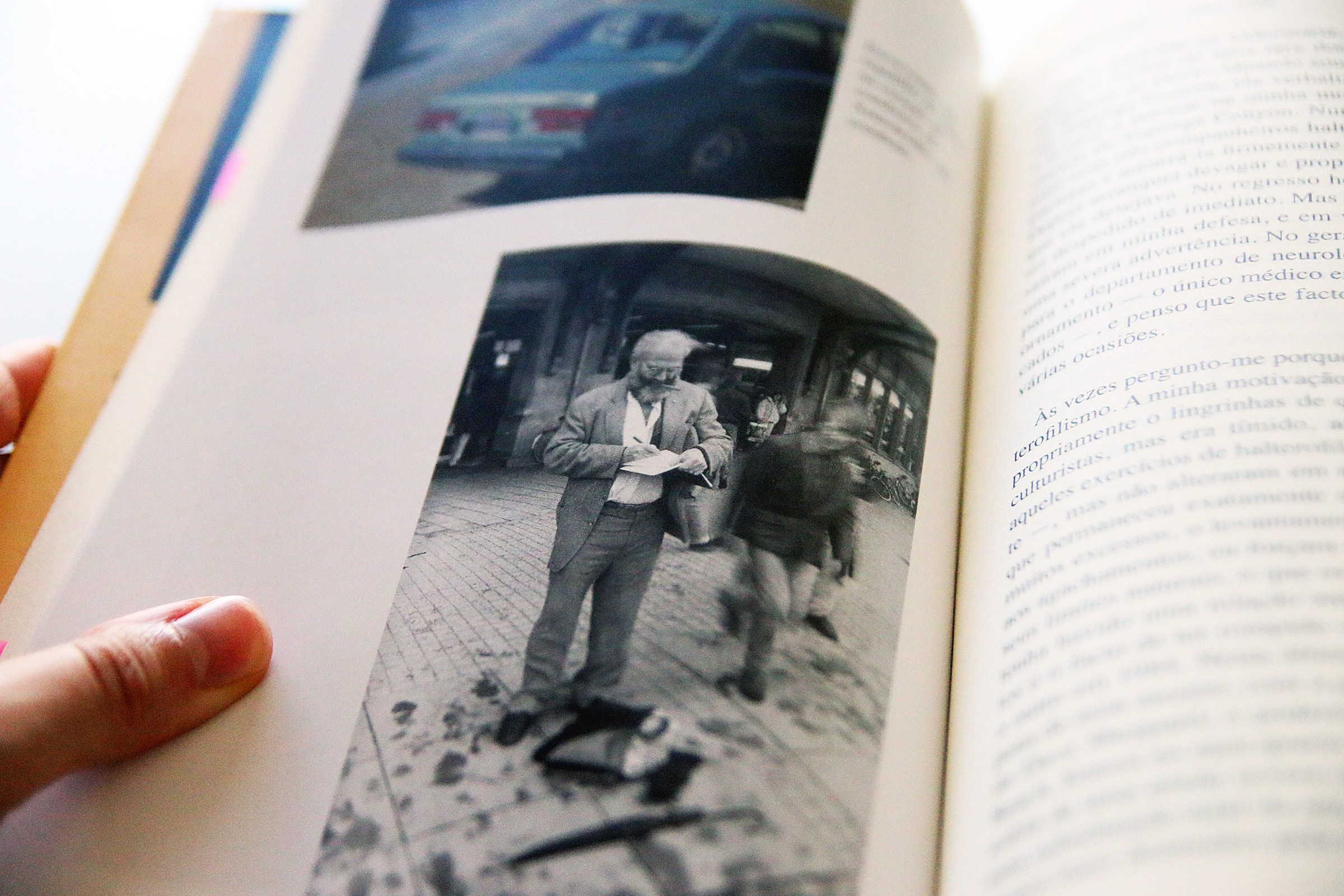
Oliver Sacks writing

Oliver Sacks writing

When I started studying and, some time later, practicing Medicine I felt that I would have to forget art forever. Medicine felt a complex science, filled with its own laws and formulas. There was always something left to learn and someone who just knew a bit more and left one feeling like a failure.

The digestive system was a whole interactive universe of organs, histological layers and difficult pathological processes. Above all, I feared saying something that was unforgivably wrong, afraid of mispronouncing a scientific term, of using the English nomenclature where the French would be more appropriate. Reading for pleasure was considered a luxury, a superfluous pleasure one could (and should) ignore.

What did change, then? Perhaps in my intimate thoughts I secretly knew it would be impossible for me to leave art for good. Even if medical encyclopedias and surgical videos had taken the place of fiction books and Malick, Bergman and Nolan’s films, something must have laid dormant inside, waiting. Thankfully, I was lucky enough to meet two people who allowed me to shift back my perspective.

On my fifth year of medical school I faced one of the most complex and demanding specialties: Internal Medicine. The mere mention of Internal Medicine seemed to evoke a subtle and persistent chill. If Medicine were Geography, Internal Medicine would be a conglomerate of countries with an impossibly vast area that was extremely difficult to explore, let alone conquer. All I could imagine were hospital corridors filled with old people, bodies filled to the brim with problems and illnesses. I In my mind, specialists in this area were grim elders who served as a distant goalpost that students should aim for – it was with this mental image that I first entered the office of my Internal Medicine professor. It was an old office, just like I had imagined. Its walls, covered with shelves of thick, worn out books, surrounded his wooden desk. On it laid scribbles and pens of various colors that had been used to explain complex clinical processes. After arriving, our professor asked us to sit down, a request to which we promptly complied. His face seemed friendly but by this time we had learned to be suspicious of initial impressions. “So, do any of you know the history behind this room we find ourselves in?”, he asked. A wave of reflection passed us by: this was probably a loaded question, one with a trick answer that we couldn’t figure out. “Nothing? Let me tell you about it.” He then proceeded to transmit us stories that culminated in important scientific breakthroughs, real or fictional, he spoke of books, people, clinical cases that he had witnessed. That semester was soon over but I will never forget the excitement of those sessions.

Years later, just after finishing college, I spent a year in a small city in the north of Portugal completing a mandatory medical internship. In that city, I spent three months on a primary health care center located right next to one of the most beautiful Portuguese rivers. At that time, I believed my future would include becoming a hospital specialist, but those months would eventually convince to become a family doctor. And I did so because of my tutor at the time, who taught me something very difficult to apprehend just by reading or attending classes: the power of stories, of active listening, of empathy. Even if I didn’t know it at the time, his words demonstrated his holistic understanding of patients. During breaks, we would discuss art, stories and travelling; I’d listen closely to him and in turn he would care about my objectives, dreams and experiences. His listening skills, empathic responses and storytelling ability helped me make a final decision to become a primary care physician and for that I’ll always be thankful to him.

IMG_2936.jpg

The importance of stories is a fundamental building block of human beings and, by extension, of healthcare professionals. It is easy to forget that everyone has a life story, especially in everyday situations where time is scarce. Art taught me to interpret and getting in touch with different ways of thinking and feeling. We’re all afraid of feeling – I believe art helps us not only to feel but also to comprehend. Active understanding and empathy are traits that one develops under the guidance of art. All different art forms – photography, painting, literature or cinema – forces us to contact realities different from one’s own and to develop our emphatic understanding. Roger Ebert, a film critic, once expressed that:

“For me, the movies are like a machine that generates empathy. If it’s a great movie, it lets you understand a little bit more about what it’s like to be a different gender, a different race, a different age, a different economic class, a different nationality, a different profession, different hopes, aspirations, dreams and fears.”

My internal medicine professor taught me the value of stories. With his serene and paused voice, he taught me that behind great scientific discoveries and medical progress lay people, contexts and sometimes chance. My general practice tutor taught me the same in a closer interaction with patients; he taught me the importance of interacting with people and validating their emotions. Without knowing it, they both helped understand the value of Art in Medicine.

When I started to work, I found myself inside a consultation room, surrounded by white walls and accompanied by a few objects sitting on my desk: a computer screen, a mouse, keyboard and a blood pressure meter. And in front of me lay a more intimidating object: an empty chair. Many people would come to sit upon that chair with an endless possibility of symptoms, complaints and reasons to seek help.

It’s difficult to convey how lonely it is to work in a consultation room. Health professionals work in a team and primary healthcare is no exception; and yet most of our work is spent inside a room alone with a patient and sometimes his family. I soon discovered that what motivated many consultations was not directly related to physical or psychological complaints. Rather, they involved familial, financial or social issues. I still remember the fear I felt when I performed my first consultations alone – fear of breaking bad news or dealing with strong emotions like sadness, anger, anguish.

Every time I’m asked how art has helped me to understand certain topics related to medicine, science or the interaction between medical professionals and patients, I’m always reminded of certain books, movies or even music albums. Literature has always had a special place in my life and certain pieces have made a big impression in my thinking.  “Beware of Pity”, written in 1939 by Stefan Zweig, served as a great way to distinguish empathy, pity and compassion. Similarly, “The Death of Ivan Ilyich”, the famous literary piece of fiction by Tólstoi, is relevant to doctors, given its approach to medical paternalism and how illness is experienced by the individual. Its story revolves around the life and death of Ivan Ilyich, a famous Russian judge that tries to maintain his status amidst a competitive society. Life takes its normal course until the moment the protagonist suffers a fall while fixing his curtains, which results in a minor back injury. Most characters surrounding Ivan are oblivious to his feelings: his fragility, pain, powerlessness and fear of dying. This miscomprehension on their part lead to his isolation and development of frustration, sadness and discouragement. His family made constant negative remarks and doctors frequently made judgements about his symptoms (“patients sometimes dream up this sort of nonsense; but we have to forgive them”) and quickly changed the subject to avoid facing his suffering. All, except for his son and his servant Guerassime, ignored the suffering that the illness inflicted in him.

IMG_2947.jpg

No matter the art form, they all help me overcome the loneliness inherent to my work. After a particularly challenging appointment, I often feel the need to be in silence and fully absorb the emotions that were expressed. However, this is often impossible due to time constraints and art serves as a sort of reflection, a kind of self-analysis that I’m not allowed at my workplace.

The importance of narrative medicine is increasingly mentioned. While not exactly a new concept, it attempts to improve the recognition of suffering and its interpretation. João Lobo Antunes, a famous Portuguese neurosurgeon, repeatedly advocated the importance of this subject:

“A new breeze soothes a body that believes itself to be solid in knowledge and skills. I’m referring to Narrative Medicine, an area that I gladly welcomed due to its ideas and principles, which I’ve long defended and taught. Many of my writings, which I modestly designated as essays, are filled with stories that distill examples of what is singularly human in the artform of treating. These are the building blocks with which I keep building my hidden curriculum and that enhance the fictional treasure trove that I’ve accumulated since my childhood.”

Today still, art helps me. I frequently come back to stories - both fiction and non-fiction. It  gives me great joy knowing Gabriel García Márquez was not alone in exploring the relationship between science and art. Fernando Pessoa, a Portuguese writer, wrote that “Science describe things as they are; art as they are felt, as one feels that they are.” Other scientists have made their remarks about this subject. Carl Sagan, an American astrophysicist that died in 1996, defended the power of imagination in science and Albert Einstein stated that “When I examine myself and my methods of thought, I come to the conclusion that the gift of fantasy has meant more to me than any talent for abstract, positive thinking.”

In science, proof is always required. It’s necessary to be sure that a certain intervention is beneficial both for patients and medical professionals alike. Some studies have tried to demonstrate that artistic interventions could bring a positive impact to certain conditions and improve communication with patients by transmitting facilitating the transmission of empathy. Regardless, it feels urgent to cultivate humanity and empathy. And art is the tool that will allow us to accomplish that. They’re not independent entities but rather complementary. I can imagine both areas as two old friend arguing at the end of a long day, as they observe light prolonging through eternity. 

Tags medicine, literature, cinema, empathy
1 Comment

On feminism and literature

June 5, 2019 Teresa Tomaz
IMG_2001.jpg

A few years ago, a dear friend – a clever and kind one – confessed to me he hated feminism. He hated how the word sounded: dull, angry, almost crude. I asked him why. “It reminds me of angry women denying men’s rights. I prefer “gender equality”. You see, I hate misogyny and men who believe they are above women. But whenever I hear the word “feminism”, I always end up thinking about women who hate men.”

I remained in silence. The Me Too movement was spreading virally at that time, and everyone was discussing feminism. I tried to remember a time when I felt left out because I was a woman. While growing up as an only child, I never felt that my parents had a different opinion about me because I was a girl. I looked up to my mother, a primary teacher, who actively contributed to our household income. She cooked, cleaned the house, took care of me and participated in every school project. But I never really thought about how she took upon herself these tasks because it was expected of her, because it was her role as a mother and a woman. “There is no need for feminism in Portugal. I believe feminism is important in some countries. But not here.” This was how my conversation with my friend ended politely and I agreed with him: “gender equality” seemed like a better word. 

But after that, I started paying attention and thinking about these issues. Something felt wrong, in a manner similar to an object that had always been there and was suddenly moved to a different place. I tried to learn more about feminism. I started by looking up the concept on the internet and found that many people used the word “feminism” as an object of personal value and power. Every clothing shop had t-shirts with powerful and empowering quotes about feminism and, like my friend pointed out, it had started to become a multimillion brand. “See? I don’t get it very well. Whenever I go to social media, I stumble across posts written by women who are offended by a song, political decision or movie. Everyone seems to overreact.” 

I had to find new sources of information and so I turned to books.

Reading has always helped me understand difficult concepts. As I sat down and analyzed my favorite novelists as a teenager - Stefan Zweig, Milan Kundera, Haruki Murakami, Tolstoy, John Steinbeck – I realized all of them were men. But as the years went on, that changed without me even noticing it. My recent shelves were filled with books written by women. Virginia Woolf, Patti Smith, Elena Ferrante, Susan Sontag, Clarice Lispector and Ursula K. Le Guin were among them.

As I was doing this recollection exercise, an old memory emerged - a man posing me the rhetorical question of why so few women had won Nobel prizes, composed musical masterpieces or written important literary pieces. “Because men are intellectually superior”, he concluded. I was 23 years old, he was five years older than me and supposedly educated. I said nothing. 

When I was younger, my online nickname was Tenar (I still use it in Postcrossing, for example). I chose it for two reasons: it was similar to my real name and the name of the main protagonist of “Tehanu”, the fourth book of the “Earthsea” series by Ursula K. Le Guin. “Earthsea” was a big turning point in my life. These books introduced me the fantasy world created by Ursula K. Le Guin, but they also taught me many important values and lessons. At the time, I did not understand how Ursula K. Le Guin, now a celebrated feminist author, struggled with women’s points of view in fiction. Tenar and her fourth book helped her, as this The Guardian article explains, representing a fictional experiment in the feminist subversion of the hero-tale.

“What I’d been doing as a writer was being a woman pretending to think like a man… I had to rethink my entire approach to writing fiction… it was important to think about privilege and power and domination, in terms of gender, which was something science fiction and fantasy had not done. All I changed is the point of view. All of a sudden we are seeing Earthsea… from the point of view of the powerless.”

Ursula K. Le Guin wrote a lot of important texts about being a woman and a feminist, including an essay called “Awards and Gender”, in which she explores the gender favoritism in writing contests. My favorite one is an essay called “Introducing Myself”, featured in “The Wave in the Mind: Talks and Essays on the Writer, the Reader and the Imagination.”

“I am a man. Now you may think I’ve made some kind of silly mistake about gender, or maybe I’m trying to fool you, because my first name ends in a, and I own three bras, and I’ve been pregnant five times, and other things like that that you might have noticed, little details. But details don’t matter. (…) I am a man, and I want you to believe and accept this as a fact, just as I did for many years.”

The reason why I really like this essay is because it made me wonder about how many things are expected of us women. Whenever I read it, I often end up thinking women were, for a long time, an invention of men: they invented an image of a young and sweet woman, forever beautiful, delicate and submissive. But what about old women? And working ones? Were women, as men invented them, allowed to grow old? Are we allowed, as a concept, to become more than mothers or housekeepers? And as Ursula K. Le Guin noted, I came to understand that we often have to think as men in order to succeed. As an author, she wrote as “a man” in her early career and struggled with it. I have always wondered why women are allowed to identify themselves with male protagonists and some of their traits, such as courage, moral values or strength, but men are not allowed to identify themselves with women. It is not acceptable for a man to admire how a woman behaves or for him to want to be like her (not in a romantic or sexual way) while the reverse is not true, as men are strong, clever, handy. In this wonderful essay, Ursula K. Le Guin refuses both youth and masculinity as the only categories of value, and she invents old women as a new category of value. I really admire how she evolved through her work and books, how she slowly integrated feminism and discovered its importance by integrating feminist ideologies into her writing. She understood that most of her early protagonists were young men and started to question notions of gender and race.

This also happened to me as a doctor. Although I belong to modern times, where female doctors have started to surpass men in terms of sheer number, I felt that during my college years we were expected to think as men. Our professors would tell us to put aside our feelings and expect us to be more sentimental than men. Years later, as a working doctor, I started to realize some patients would trust more a man than his female counterpart. They expected them to be the doctor. Whenever they saw me, they would doubt if I were capable of doing the same thing as them. They would question if I was married or a mother. As soon as they got used to me, that started to change, but I realized that people still judge actions based on gender. 

“But I failed. I did nothing. I absolutely failed to stay young. And then I look back on all my strenuous efforts, because I really did try, I tried hard to be a man, to be a good man, and I see how I failed at that. I am at best a bad man. (...) If I’m no good at pretending to be a man and no good at being young, I might just as well start pretending that I am an old woman. I am not sure that anybody has invented old women yet; but it might be worth trying.”
― Introducing Myself, Ursula K. Le Guin

Besides Ursula K. Le Guin, there was also a writer who was a great influence in my earlier years. As I’ve mentioned before, Virginia Woolf is one of my favorite writers. Her novel “The Waves” always spoke to me and it was a huge influence when I read it. Like her fiction, her essays are outstanding. Like Ursula K. Le Guin, Virginia Woolf had to fight not only against those who surrounded her, but also one of her greatest lifetime opponents: herself. In 1931, she gave a speech called “Professions for Women”, which was later included as an essay in “Other Essays”, in which she explored her own experiences as a writer. First, she had to fight against an inner voice who told her she could not be harsh with men, as women were supposed to be gentle and pure. After that, she had a greater obstacle to overcome: 

“These were two of the adventures of my professional life. The first--killing the Angel in the House--I think I solved. She died. But the second, telling the truth about my own experiences as a body, I do not think I solved. I doubt that any woman has solved it yet. The obstacles against her are still immensely powerful--and yet they are very difficult to define. Outwardly, what is simpler than to write books? Outwardly, what obstacles are there for a woman rather than for a man? Inwardly, I think, the case is very different; she has still many ghosts to fight, many prejudices to overcome. Indeed it will be a long time still, I think, before a woman can sit down to write a book without finding a phantom to be slain, a rock to be dashed against. And if this is so in literature, the freest of all professions for women, how is it in the new professions which you are now for the first time entering?”

Virginia Woolf inspired women to fight for equal rights. She also wanted women to fight against stereotypes and against the accepted masculine style of their time, a time when women were only successful if they wrote as men. Reading her texts showed me that it is not enough to have rights; it is necessary to also fight injustice. She also explores how men address women as writers. In her essay “Women Novelists”, she worries how men often see women’s work as “sentimental and funny”, but never “imaginative” or “genuine”. On the other hand, she also tries to understand why so few classical books were written by women throughout the centuries. This gave me opportunity to think about the incident I described before. With her writings, Virginia Woolf gave me confidence to reply to any man or woman who would state women were inferior to men. 

Reading Elena Ferrante’s novels – not only the Neapolitan Novels, but also her other works, such as “The Days of Abandonment” or “The Lost Daughter” – was my biggest influence regarding feminism in the past years. In “Fragments”, Elena Ferrante explores her work and her complex characters, including those from “The Neapolitan Novels”. She explores the patriarchal and violent environment of Napoles, the way the characters are influenced and oppressed by men. For instance, Elena Greco compares herself to her male colleagues and writers; Nino states he admires her but still considers himself intellectually superior. He also has the right to have multiple affairs because he is a “genius”. Often her female characters are afflicted by the influence of a patriarchally male society, and this helps the reader to challenge the conventionally accepted forms of many subjects, such as feminism, marriage and motherhood.

“Fragments” is a compilation of Elena Ferrante’s interviews and thoughts. She says:

“Every woman novelist, as with women in many other fields, should aim at being not only the best woman novelist but the best of the most skilled practitioners of literature, whether male or female. To do so we have to avoid every ideological conformity, every false show of thought, every adherence to a party line or canon.”    

 She also states in her weekly column on The Guardian:

“Women live amid permanent contradictions and unsustainable labours. Everything, really everything, has been codified in terms of male needs – even our underwear, sexual practices, maternity. We have to be women according to roles and modalities that make men happy, but we also have to confront men, compete in public places, making them more and better than they are, and being careful not to offend them.

(…)

The consequence is that not only is female power suffocated but also, for the sake of peace and quiet, we suffocate ourselves. Even today, after a century of feminism, we can’t fully be ourselves, don’t belong to ourselves. Our defects, our cruelties, our crimes, our virtues, our pleasure, our very language are obediently inscribed in the hierarchies of the male, are punished or praised according to codes that don’t really belong to us and therefore wear us out. It’s a condition that makes it easy to become odious to others and to ourselves. To demonstrate what we are with an effort at autonomy requires that we maintain a ruthless vigilance over ourselves.”

After I read these words, I became much more aware to feminism and its importance. I became more informed, I felt I had more arguments to fight against inequality. When people state they don’t like the words “feminism” and instead prefer “equality”, I often reply with Chimamanda Ngozi Adiche words:

“Some people ask: “Why the word feminist? Why not just say you are a believer in human rights, or something like that?” Because that would be dishonest. Feminism is, of course, part of human rights in general—but to choose to use the vague expression human rights is to deny the specific and particular problem of gender. It would be a way of pretending that it was not women who have, for centuries, been excluded. It would be a way of denying that the problem of gender targets women.”
― We Should All Be Feminists, Chimamanda Ngozi Adiche

I cannot end this post, however, without mentioning Margaret Atwood’s “The Handmaid’s Tale”. A few days ago I was travelling by train to Oporto when a girl sat next to me. I was reading a book by the window; the day was sunny, and the train was crowded. People were talking loudly, and amongst the noise and music playing here and there, I was picturing a beach and a Japanese family, imagining the world portraited by Yukio Mishima. The girl was in her early twenties, and I noticed her blonde hair shining next to me, reflecting the sunlight; it reminded me of a dress hanging outside drying, an image I often saw when I did this journey. The girl opened her book: it was “The Handmaid’s Tale”. She started to read, apparently unaware of the noise. Then, she grabbed a pencil and wrote four words after reading a paragraph: “Women oppressed by men.”

I smiled when she did that. It always pleases me deeply whenever I see someone (especially someone as young as her) reading and taking notes. I closed my book and I looked outside the window, feeling my smile slowly fade away. Despite having been published 37 years ago, I could not wonder how far from reality its story was. Female genital mutilation is still documented in many countries. Abortion restrictions are rising in many countries, which can ultimately lead to illegal abortion practices that endanger women’s lives. Margaret Atwood’s story does not seem implausible at all.

And this is why, I believe, reading is getting more and more crucial. In her book “Dear Ijeawele or a Feminist Manifesto in Fifteen Suggestions”, Chimamanda Ngozi Adiche says:

“Teach Chizalum to read. Teach her to love books. The best way is by casual example. If she sees you reading, she will understand that reading is valuable. If she were not to go to school, and merely just read books, she would arguably become more knowledgeable than a conventionally educated child. Books will help her understand and question the world, help her express herself, and help her in whatever she wants to become – a chef, a scientist, a singer all benefit from the skills that reading brings. I do not mean schoolbooks. I mean books that have nothing to do with school, autobiographies and novels and histories. If all else fails, pay her to read. Reward her.”

A few months ago, my friend talked to me again about feminism. I don’t remember why he did it, but he was wondering again about the importance of feminism nowadays. I told him I did not agree with him. I explained why. Some of the reasons are written above in this post. He listened to me in silence. In the end, he told me: “I have never looked at feminism through that perspective. Maybe I had in mind a different kind of feminism. I will try to learn more about it.”

I have written about how some people would judge me as a professional because I was a woman. I was prepared for that, but I was not prepared for other things. Some fellow women doctors confided with me that the first thing they would be asked whenever they started working in new place was: “are you planning to have children?” They’d always fear this question, they said. A person even mentioned that one of her superiors sighed when meeting her and realizing her gender. “Great, another future childbearing person who won’t have a 40 hours schedule because she is eventually going to get pregnant.” The assumption seems to be widespread– if you’re a woman, that means you’ll have to eventually become a mother. And what if I don’t want to be a mother? Perhaps I won’t be seen as a fully grown up woman until I do have children. But I will also be a burden, a problem, a pain if I have them.

Feminism is important. Don’t let them make you think otherwise, regardless of your gender. And if you start to doubt of its importance, read. Read, and read, and read until you remember that again. And fight with those words. You don’t need to shout in the streets to make a difference if you don’t want to. You can start in your home, with your kids and friends. Just as I did with mine. 

Tags feminism, Elena Ferrante, Virginia Woolf, Ursula K. Le Guin, Margaret Atwood, Chimamanda Ngozi Adichie
Comment
← Newer Posts Older Posts →

Powered by Squarespace